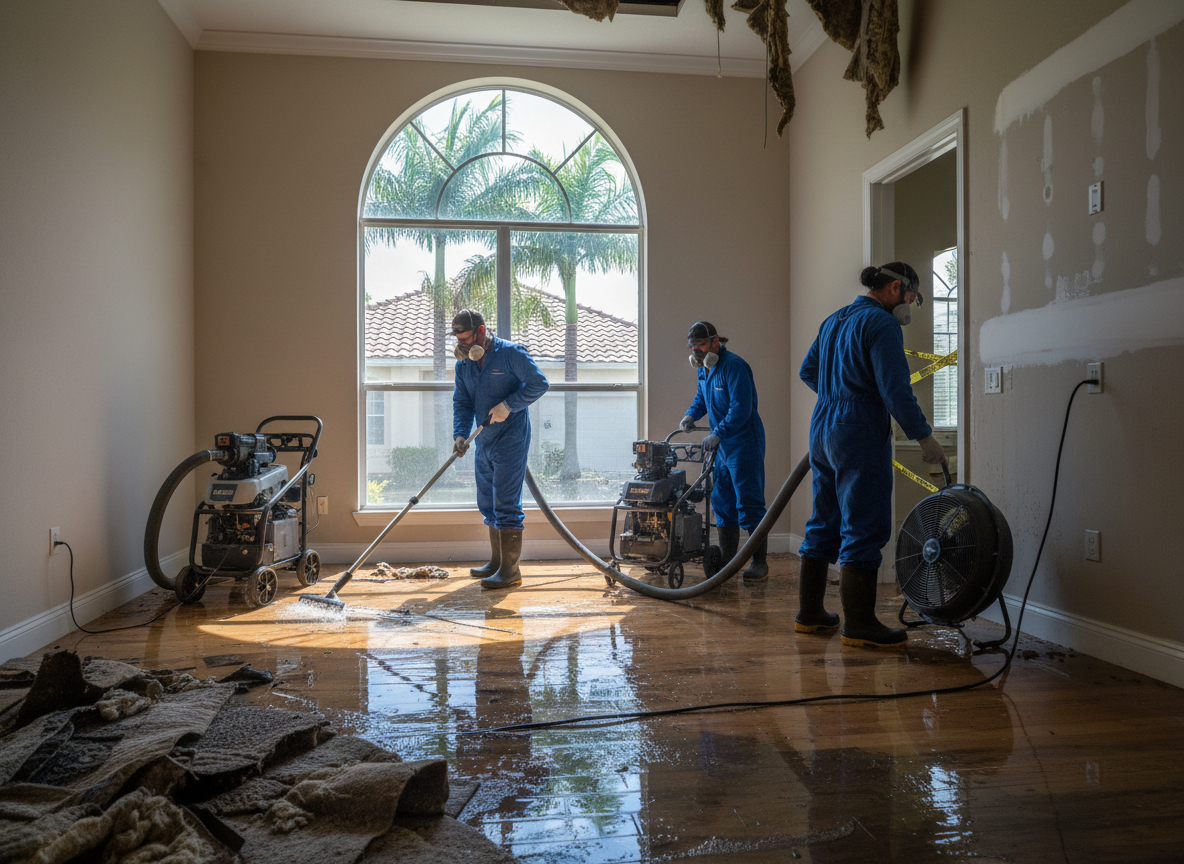
Water damage in West Palm Beach usually shows up somewhere other than where it started. A baseboard gives when you press it in a hallway with no plumbing, a ceiling stain appears below a bathroom that was retiled years ago, or the floor feels cool in one patch beside a cabinet. Water restoration in West Palm Beach begins by finding the path the water took, because the visible wet patch is usually the end of that journey rather than the beginning.
Why West Palm Beach owners call us for water restoration
On site we read the rooms with pin meters and non-invasive meters, use a thermal camera where a wall or ceiling is suspect, and mark every reading by room and location. A wall that feels dry at the surface can still be wet at the bottom plate, and in this climate that is the ordinary case rather than the exception. Each reading is compared with a dry reference of the same material, so drying is judged on numbers instead of on how a room feels.
We also separate the emergency from the rebuild in writing. Pumping water out, removing saturated pad and drying framing is one scope. Replacing a failed supply line, closing a roof, rebuilding a cabinet run and repainting are another. One written scope names the boundary, so you can see what is being done now and what is a later decision. It also stops the drying being cut short so that the repair can start sooner.
And we read the building in front of us. A 1920s bungalow in a historic district, a 1950s block house west of downtown, a 1970s ranch near Military Trail and a lagoon-front condo all hold water differently. Stucco over block can hide moisture in the block core; terrazzo over slab can trap it in the mortar bed; a low-pitch roof moves wind-driven rain in ways a hip roof does not. One script does not fit all four.
The findings are yours to keep. Photographs, moisture maps and the written scope are handed over rather than held back, because you may need them for an insurer, a landlord, an association or a later repair. We do not decide coverage for you, and we do not tell you that a claim will be approved.
Why a wet West Palm Beach house cannot wait until next week
Palm Beach County sits in a humid subtropical climate where the air is close to saturated for much of the year. That changes the clock on a water loss. In a dry climate, wet framing might sit for a week while you organise a contractor. Here, a wall cavity that stays damp is a growth chamber, and the materials most likely to be affected are the ones you cannot see: paper-faced drywall, wood studs, insulation and the paper backing on stucco lath.
Mold needs moisture, organic material and time. The first two are already inside your wall. Growth can begin within days of a leak starting, which is why the calls that worry us most are the quiet ones: a slow supply-line weep behind a vanity, an air handler that has been dripping into a ceiling pan since May, a washing machine hose that has been misting the same stud bay for months. By the time a smell or a stain appears, the clock has usually been running for a while.
Then there is the season. The Atlantic hurricane season runs from 1 June to 30 November, and South Florida's heaviest rain usually arrives inside that window. West Palm Beach has another path for water that has nothing to do with rain: autumn king tides push the Intracoastal and the Lake Worth Lagoon higher than the storm drains were built for, and low streets near the water can take water without a drop falling from the sky. A house that takes water once often takes it again, and the second time is easier because the first repair was never finished properly.
Delay has a cost that has nothing to do with our invoice. Materials that could have been dried are instead removed and replaced. Cabinets that could have been saved swell and are torn out. A room that needed airflow for a few days needs containment, negative air and demolition instead. The water job that ends with the least removal is the one that starts while the drywall is still salvageable.
What you can check about this business before you call
Mold Remediation West Palm Beach Florida works from 1990 Kirk Rd, Palm Springs, FL 33406, in Palm Beach County, and the phone number is (561) 960-0937. That address is where the work is run from, and it is the address you will find in the footer, on the contact page and in the structured data on this site.
The services on this site are the whole list: water restoration, which covers water removal, storm damage, water leak detection and water extraction, and mold remediation. We are not presenting a longer menu we cannot deliver.
The areas are the eight listed on the service-area pages: Palm Beach, Lake Worth Beach, Greenacres, Royal Palm Beach, Lantana, Riviera Beach, Atlantis and Ocean Ridge, plus West Palm Beach itself. Every one is in Palm Beach County.
What this site does not publish is a contractor licence number, trade certifications, insurance certificates or a founding year. Those are not facts we can put in front of you here, so we have not invented them. If a licence, certification or insurance detail matters to your decision, ask on the call and we will tell you what currently applies rather than point at a badge.
A 1950s block house near the lagoon after an autumn king tide
A call that stays with us came from a single-storey block house a few streets west of Flagler Drive. It was built in the 1950s, with terrazzo floors, a carport that had been enclosed as a Florida room, and a flat-roof addition at the back. The water arrived in October on a king tide, not in a storm. The lagoon backed up, the street drain could not take it, and an inch crossed the threshold at the side door overnight. The owner mopped, put a fan in the room and waited four days for the floor to dry.
By the time we were called, the terrazzo felt cool in a patch that ran from the door to the middle of the room, the baseboard on the interior wall was soft, and the closet beside the bathroom smelled musty. Nothing was visibly wet. The meter told a different story: the block at the base of the wall was holding water well above the visible tide line, the mortar bed under the terrazzo was still damp, and the addition's slab fell slightly toward the original house rather than away from it.
That combination is common on this side of the city. Block wicks water upward through the core, so the wet zone sits higher than the water line and the paint on the interior face can look perfect. Terrazzo is dense on top and porous underneath, so the mortar bed stays wet long after the surface is dry to the touch. A flat-roof addition tied into an older wall creates a seam where water can travel sideways, and an enclosed carport often has its own slab that was never graded for a tide.
Floodwater that comes in from the street is not clean water. It has crossed pavement, lawns and drains, so it is treated as contaminated, which means saturated carpet, pad and any porous material it reached are removed rather than dried in place. We cut the baseboard and the lower drywall on the affected walls, removed the wet insulation, dried the block and the slab with air movement and dehumidification, and treated the salt residue that floodwater leaves behind. Salt is hygroscopic: it pulls moisture out of the air, so a wall that looks dry can start reading wet again if the residue is not dealt with.
The repair list was just as important as the drying. The side door needed a threshold that sits above the tide level, the addition needed the seam at the original wall checked by a contractor, and the exterior grade needed to fall away from the house. None of those is restoration work. All of them are why the same room would have flooded again the following October if the job had stopped at the drying equipment.
Which parts of a West Palm Beach house fail first?
Four components account for a large share of the water calls we take in this city. Each behaves differently, and each gives you a different first clue.
A supply line that lets go inside a wall
The component is the pressurised side of the plumbing: the braided steel hose behind a toilet or washing machine, the angle stop under a sink, the copper or PEX run inside a wall, and the fittings that join them. In a West Palm Beach house of any age, the most common failure is at a connection rather than mid-pipe: a corroded angle stop that snaps when someone turns it, a braided hose that has been kinked behind an appliance since installation, or a plastic fitting that has been under pressure and heat for decades. What you notice is often not the leak itself but its shadow: a soft baseboard in the next room, a bulge in the paint, a water bill that climbs without explanation. The first move is to shut the water off at the fixture or the main, then read the wall before anyone opens it, because a supply-line leak travels along the stud bay and can surface well away from the stain.
A water heater in a hall closet or garage
The component is the tank, its inlet and outlet connections, the temperature and pressure relief valve, and the drain pan underneath. Many West Palm Beach homes put the heater in a hall closet, a garage corner or a utility alcove, so a failure has a short path into drywall, baseboard and flooring. Tanks usually fail from the inside out as the liner corrodes, so the first sign can be rust-coloured hot water, a faint metallic taste, or moisture at the base of the tank rather than a burst. The relief valve is a separate failure: if it drips continuously, the pan drain is doing the work, and if that drain is blocked or missing, the closet floor takes the water. What you notice is a musty smell in the hallway, paint lifting on the closet wall, or a warm spot on the floor. The first move is to shut off the power or gas and the cold inlet, then get the water out of the pan before it reaches the wall plate.
A slab leak under tile or terrazzo
The component is the plumbing that runs beneath the floor slab, usually the hot-water line, and the slab and finish above it. A pinhole or a failed fitting under the slab does not announce itself. Water follows the path of least resistance through the fill and can surface at a wall base, inside a cabinet, or as a warm patch on a tile or terrazzo floor. Other clues are a water bill that rises without a change in use, a water heater that runs more than it should, or a baseboard that stays damp in a room with no plumbing on that wall. Detection comes before demolition: isolate the system, read the floor and walls with meters, and use thermal imaging to see the warm line under the finish. The repair belongs to a plumber; our job is to dry what the leak wet without breaking more of the floor than the diagnosis justifies.
An air handler that has been dripping since June
The component is the condensate management on the air-conditioning system: the primary drain line, the secondary pan, the float switch that should shut the unit down when the pan fills, and the air-handler closet itself. In this climate the system runs for most of the year and produces a steady stream of condensate, so a partly blocked drain is not a small problem. Algae and biofilm build up in the line, water backs into the pan, and the overflow lands on the platform, the closet floor and the ceiling below. What you notice is a musty smell when the air comes on, a water stain on the ceiling of the room below the air handler, or a closet that feels damp. The first move is to turn the system off at the thermostat, clear the pan, and read the ceiling and closet framing before the unit runs again, because a wet platform keeps feeding moisture into the same assembly every day.
The four jobs inside water restoration in West Palm Beach
Water restoration on this site is one service with four named parts. They are not separate pages, because on a real job they overlap: a storm pushes water in, extraction takes it out, detection finds where it is still coming from, and removal takes out what cannot be saved.
Water Extraction
Extraction is the wet phase. It starts with stopping the source if that has not already happened, then removes standing water and the water held in carpet, pad and seams before anything is dried. It is the part of the job that decides how much of the building survives.
The steps we follow:
- Confirm the source and the water category before touching anything, because grey or contaminated water changes what can be saved.
- Photograph the affected rooms and record the water line before it is disturbed.
- Pump or vacuum standing water out of the room, including from beneath furniture and inside cabinet bases.
- Remove saturated carpet and pad, and extract the seams and edges a pump cannot reach.
- Detail-extract wall bases, cabinet toe kicks and floor transitions, then set drying equipment against marked readings.
What's included in the extraction phase:
- Standing-water removal with portable or truck-mounted extraction equipment
- Water-category assessment before removal, explained in plain terms
- Removal and disposal of saturated pad, carpet and unsalvageable material
- Detail extraction at wall bases, cabinet toe kicks and floor seams
- Containment where contamination or visible growth is present
- Photographs and a written record of what was removed and why
Water Removal
Removal is the controlled demolition that follows extraction. It covers the material that is too wet, too contaminated or too deteriorated to dry in place, and it is done to a measured line rather than by stripping a room.
The steps we follow:
- Mark the wet boundary with readings and explain what is coming out before anything is cut.
- Move and protect contents, and isolate the work area from the rooms that are still usable.
- Remove drywall, insulation, baseboard or flooring only where the readings and the water category justify it.
- Bag and carry material out through one route so contamination is not spread through the house.
- Clean the hard surfaces left behind, then re-read the assembly before drying begins.
What's included in the removal phase:
- Controlled removal of drywall, insulation, baseboard and flooring that cannot be dried
- Contents handling and furniture protection in the work area
- Bagging and disposal of removed material
- Cleaning of studs, block and slab left exposed after removal
- A written and photographic record of what was taken out
Water Leak Detection
Detection answers the question that decides the whole scope: is the water still coming in? It sits inside water restoration and storm damage because a leak that is not found will wet the same cavity again after the drying equipment leaves.
The steps we follow:
- Talk through when the water appeared, what the building was doing at the time, and whether the bill has changed.
- Read the walls, floors and ceilings with pin and non-invasive meters, and scan suspect areas with thermal imaging.
- Isolate the supply, drain and exterior paths to see which one changes the reading.
- Trace the path from the likely entry to the material that is actually wet, and mark it.
- Report what was found in writing and name the trade that owns the repair.
What's included in leak detection:
- Moisture mapping at marked points
- Thermal imaging of concealed walls, ceilings and floors
- Isolation testing of supply, drain and exterior water paths
- A written finding with photographs
- A named hand-off to a plumber, roofer or window trade where the repair is theirs
Storm Damage
Storm damage is the wind-and-rain side of the same job. It covers the water that comes in through the building envelope, and the groundwater that rises after the rain stops, without pretending to be a roofing or glazing contractor.
The steps we follow:
- Make the interior safe: keep people out of rooms with wet ceilings, and isolate water near outlets and panels.
- Photograph the damage before anything is moved, including the exterior path where it is safe to reach.
- Stop or limit the entry where that can be done safely, and record what was done.
- Extract standing water, remove saturated material and dry the interior against readings.
- List the roof, window, door and lanai repairs that belong to another trade, in writing.
What's included in storm damage response:
- Interior water extraction and removal after wind-driven rain
- Leak tracing from the ceiling, window head, door track or lanai tie-in
- Structural drying with recorded readings
- Photographs and a moisture log for an insurer or property manager
- A written hand-off to the roofer, glazier or contractor who owns the envelope repair
How a water restoration job here runs, step by step
- Call and describe the water. Say where it is, when it appeared and whether it is still running. We tell you what to shut off if it is safe to reach, and which rooms to keep clear.
- Read the building before anything moves. We map the wet area with meters and thermal imaging, mark the points and photograph the readings. Nothing is opened before it is read.
- Stop the source and protect the rooms. Water is shut off where that is safe, contents are moved clear, and containment goes up where growth or contamination is present.
- Extract, remove and dry. Standing water comes out first, then saturated material, then air movers and dehumidifiers run against daily readings rather than on a timer.
- Verify and hand back. Final readings are compared with day one, the rooms are walked with you, and you get the photographs, the moisture log and the list of repairs that belong to another trade.
What is the next step in West Palm Beach?
Call (561) 960-0937 and describe what you are seeing: where the water is, when it appeared and whether it came from the ground, a wall or above. We will tell you what to keep clear, what to shut off if it is safe, and what the first visit will involve. If the source is a roof, a window or a plumbing line, we will say so before you book anything.
How it works
- 1
Call and safety guidance
You describe what is wet, where it came from and whether water is still running. We tell you what to shut off if it is safe to reach and which rooms to keep clear.
- 2
On-site moisture map
We read the affected rooms and a dry reference area of the same material, mark each point and photograph the meter before any material moves.
- 3
Extraction and removal
Standing water comes out first, then saturated pad, carpet and material that cannot be dried or has absorbed contaminated water.
- 4
Drying and daily readings
Air movers, dehumidifiers and cavity drying run against recorded readings, adjusted daily rather than left on a timer.
- 5
Final check and hand-back
We compare final readings with day one, walk the rooms with you and leave a written record plus the list of repairs that belong to another trade.