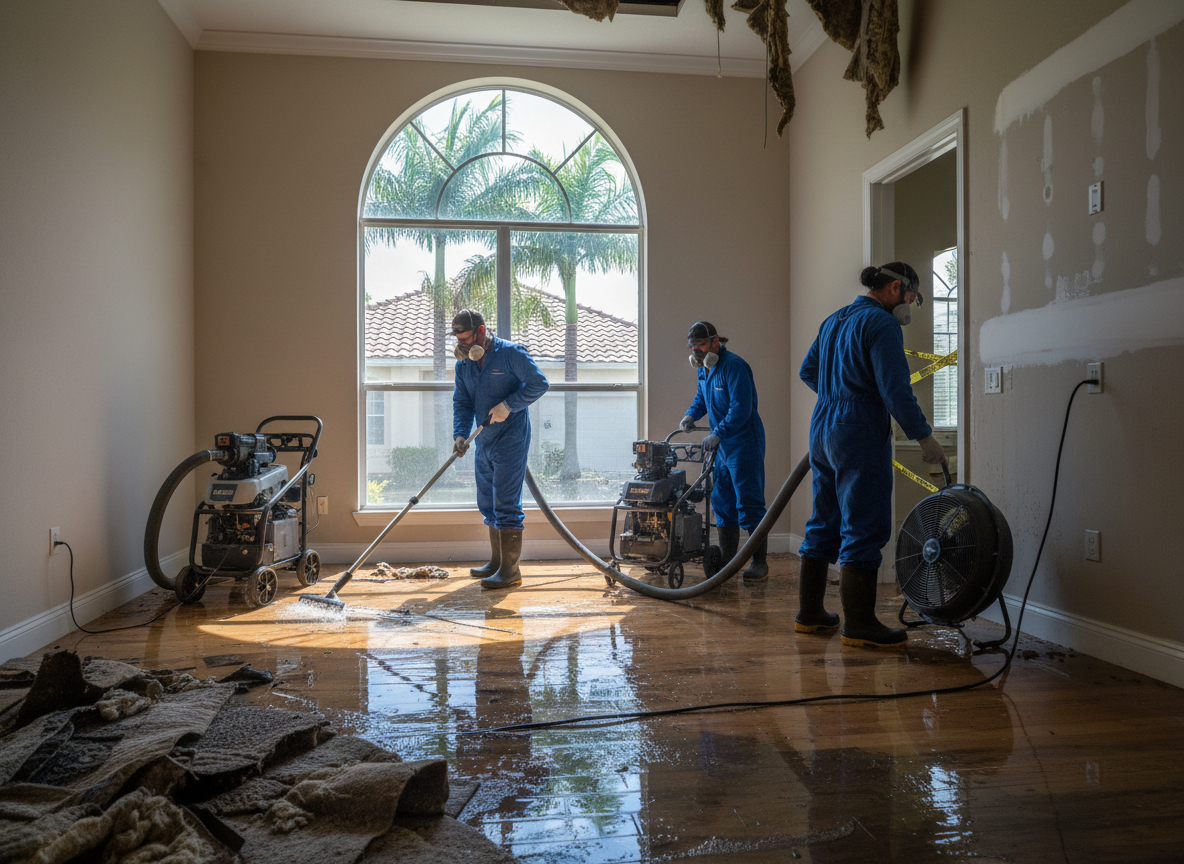
Greenacres is an inland Palm Beach County city of about 44,000 people, platted in 1923 and built out mostly from the 1970s. There is no ocean surge here, but flat ground, a shallow water table and a canal system mean heavy rain has nowhere to go quickly. That is the condition behind most water damage in Greenacres, and it is what this page is about.
What makes water damage in Greenacres different?
Greenacres floods from rain rather than from surf. The city is flat, the water table is close to the surface, and the housing stock is mostly 1970s to 1990s construction on slab. Water ponds in swales and yards, finds the lowest wall base, and gets into air-handler closets and cabinet bases that were never designed to stay dry.
Inland flooding, not surf
Greenacres sits in central Palm Beach County, west of Lake Worth Beach and east of Royal Palm Beach. The city has no coastline and no lagoon frontage, so the storm-surge story that dominates the coastal towns does not apply. What does apply is rainfall. The ground is flat, the soil is sandy and the water table is shallow, so a slow storm or a series of afternoon thunderstorms can saturate the ground and leave water standing for days. The city's history includes the 1928 Okeechobee hurricane, which damaged practically every building in Greenacres City, and the pattern of water arriving from the sky rather than the sea has not changed. Flood maps are parcel-specific, and the county publishes the maps used for insurance and emergency planning.
A city that grew after 1970
Greenacres was platted in 1923 by C. A. Swain, with the original section laid out west of Military Trail. It was incorporated as Greenacres City on 24 May 1926, disincorporated in 1945 and reincorporated in 1947. For decades it stayed small; the rapid growth came in the 1970s, and full-time police and fire departments were established around the same period. That timeline is visible in the housing. Most of the city is ranch houses, villas and townhomes built from the 1970s through the 1990s, on slab foundations with truss roofs and air handlers in closets, garages or utility alcoves. The older pre-war houses cluster near the original plat, and they behave differently from the later subdivisions.
Flat ground, sand and a shallow water table
There is very little grade in Greenacres. A lot that looks level can fall a few inches toward the house, and that is enough to send water to a wall base during a heavy storm. The soil is sandy, which drains quickly until it is saturated and then holds water near the surface. Subdivisions built from the 1970s onward typically drain to retention ponds and a canal network rather than to a slope, so when those systems are full, water sits in swales and against fences. Homes here do not have basements, so water that gets under a slab spreads sideways until it reaches a wall plate or a cabinet toe.
Who serves a Greenacres address
The City of Greenacres is its own municipality, with its own police and fire departments, and building permits and local drainage questions run through the city. Palm Beach County publishes the flood maps and runs countywide emergency management, and the regional canal system is managed at the water management district level. That means a flood-zone question and a permit question can have two different answers from two different offices. We do not answer either on the city's behalf; we tell you what we found in the building and point you to the office that owns the record.
What do Greenacres homes actually need?
- Water restoration is the first stage for a Greenacres house: extraction, storm response, leak detection and drying, planned around a slab that sits close to the water table.
- Mold remediation is the second stage when a wall base, a lanai wall or a closet has stayed damp long enough for growth to show.
Why use our Palm Springs crew in Greenacres?
Our base at 1990 Kirk Rd in Palm Springs is about two and a half miles from Greenacres, so equipment and a crew reach the city quickly. What matters more is that we read the construction of this era properly: slab-on-grade, truss roofs, air handlers in closets and garages, and cabinet runs that hide the wall base. We write the scope before work begins, record readings at marked points and tell you plainly when the source repair belongs to a plumber or a roofer. We do not list licence numbers, certifications or reviews for Greenacres work, and we will not invent them to sound established.
Why Greenacres water damage gets worse quickly
The flat ground that makes Greenacres comfortable also makes it slow to drain. After a storm the street may clear while the swale, the yard and the wall base stay wet, and a damp slab keeps the indoor humidity high in every room it touches. In this climate, drywall paper, insulation and wood studs can support mold growth within days of staying damp. The air-conditioning system adds a second, quieter source: a partly blocked condensate line keeps the closet platform wet all summer, and the ceiling below the air handler is often the first place a stain appears.
Hurricane season runs from 1 June to 30 November, and the city's heaviest rain usually arrives in that window, often as afternoon thunderstorms rather than a named storm. A 1928 hurricane damaged practically every building in the city, and while construction has changed, the drainage pattern has not. Delay has a direct cost: material that could have been dried is removed, cabinets that could have been saved swell, and a room that needed airflow for a few days needs containment and demolition.
Greenacres grew fastest in the 1970s, and much of that housing was built with the air handler in a closet or on a platform inside the conditioned space. When a condensate line blocks, the first sign is often a damp closet floor or a stain on the ceiling below rather than a visible leak. The city was platted in 1923, incorporated in 1926 and reincorporated in 1947, and the street pattern still shows those layers. On an inland lot with no ocean exposure, the more common call is a slab that stays wet after heavy rain, a water heater in a garage, or a lanai holding water against the house.
How a Greenacres job runs, step by step
- Call and locate the water. Tell us whether it is a supply line, the water heater, a lanai, the roof or water that came in at the slab. We ask which intersection you are near, because the inland lots here drain toward different canals.
- Read the slab and the walls. Greenacres houses mostly sit on slab-on-grade, so readings start at the floor edge and move upward through block or frame walls. A dry reference is taken from an interior wall in a room that never flooded.
- Protect the rooms in use. Furniture is lifted or moved, contents are boxed away from the work area, and containment is set where a bedroom or kitchen opens directly onto the wet room.
- Extract, remove and dry against a high water table. Standing water is extracted, saturated baseboard and pad come out, and drying is adjusted for a slab that keeps pulling moisture from the ground beneath it.
- Verify and hand back. Final readings are compared with day one, the moisture log is handed over, and anything that belongs to a plumber, roofer or the city is written down.
What's included on a Greenacres job:
- A written scope that separates the water event from any long-standing ground moisture
- Slab-edge and wall-base readings rather than a single carpet reading
- Extraction of standing water and removal of saturated pad, baseboard and drywall
- Drying that accounts for a water table close to the slab
- Containment and HEPA filtration where a lanai or garage has stayed damp
- Photographs and a moisture log for an insurer, landlord or HOA
- A written hand-back listing the plumbing or roofing repair still outstanding
Nearby areas we serve from Greenacres
The towns closest to the city are Lake Worth Beach, Lantana, Palm Beach, [West Palm Beach](/) and Royal Palm Beach, all within about ten miles of the city centre. Each page covers that town's own housing and drainage rather than repeating Greenacres' inland story.
What is the next step in Greenacres?
Call (561) 960-0937 and describe where the water appeared and how long it has been there. We will tell you what to lift off the floor, which rooms to keep out of use, and what the first visit will involve on a slab-on-grade house.
Around Greenacres
We regularly work near:
- 📍Lake Clarke Shores
- 📍Military Trail
- 📍Greenacres City Hall
- 📍Palm Springs
- 📍Lake Worth Road
Mold Remediation in Greenacres — Local Notes
- •Platted 1923; incorporated May 24, 1926; reincorporated 1947
- •Rapid growth began in the 1970s
- •Inland city with no ocean or lagoon frontage
- •Own police and fire departments