Mold in West Palm Beach rarely starts in the room where you notice it. The smell is strongest in a back closet, the stain is on a ceiling in a hallway, or the paint at the base of a bedroom wall has begun to lift, and none of those rooms has plumbing on the wall that is wet. Mold remediation in West Palm Beach starts with the moisture that made the growth possible, because removing what you can see without correcting that source only buys a few months.
Why West Palm Beach owners call us for mold remediation
We treat mold as a moisture problem with a visible symptom. The first visit is spent finding the water path, not spraying the wall. We read the affected rooms with moisture meters, scan concealed walls and ceilings with thermal imaging where the finish looks sound, and compare each reading with a dry reference of the same material. The wet boundary is marked so the work area is defined by measurement rather than by how far the discolouration appears to spread.
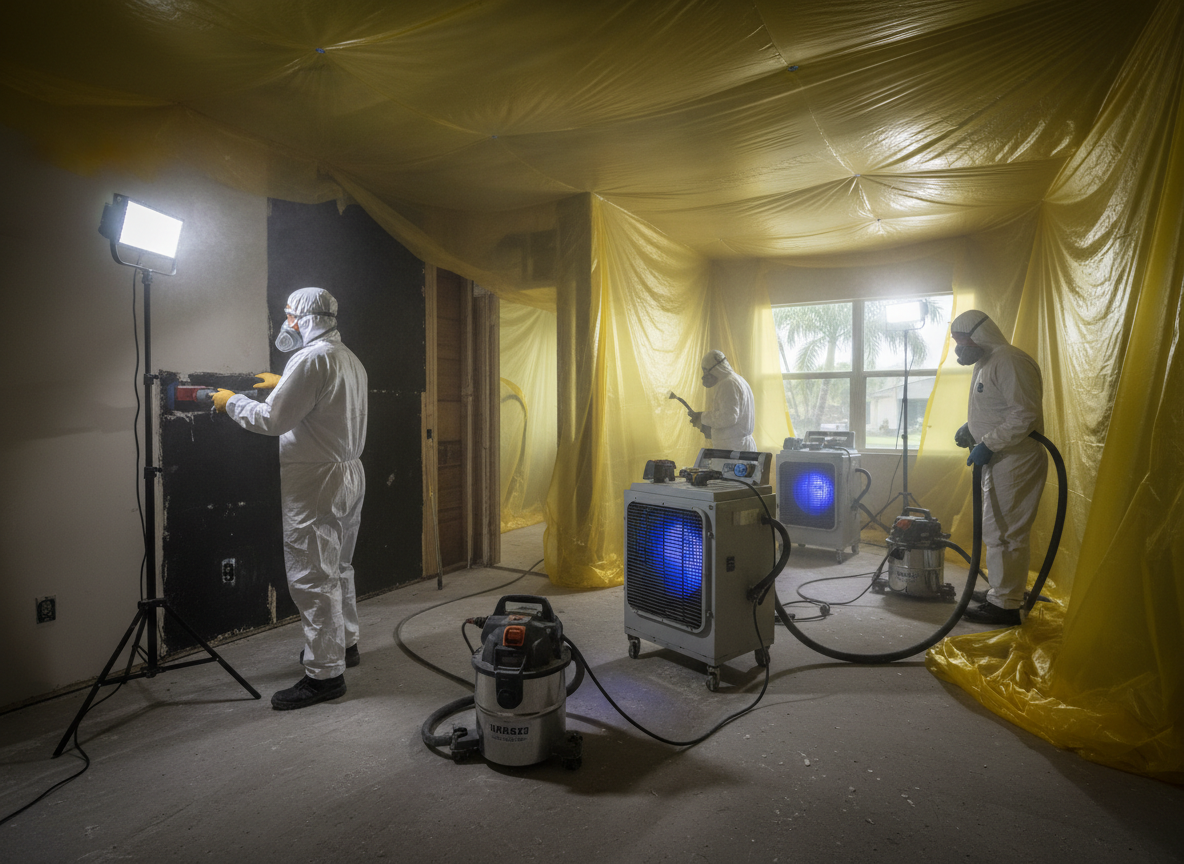
Containment comes before removal. Where growth is present or the material is likely to be disturbed, the work area is isolated with plastic sheeting and negative air pressure, and the air leaving the space passes through a HEPA filter. That protects the rooms you are still living in and stops spores from being spread by the very work that is meant to remove them. The containment is checked before anyone starts pulling material down.
We separate cleaning from removal, and we say which is which. Painted or sealed hard surfaces can often be cleaned and dried. Porous material that has supported growth, such as drywall paper, insulation, carpet pad and the back of a cabinet, usually cannot be cleaned well enough to leave in place, so it comes out. The decision is made on the material and the moisture reading, not on a sales target.
The source correction is written into the scope. A mold job that ends with the removed material bagged and the wall rebuilt, but the supply line still weeping or the roof still leaking, has moved the problem rather than solved it. We name the repair, tell you which trade owns it, and put it in the hand-back record. We also do not publish certifications we do not hold, so if you need a particular credential for a landlord, an insurer or a sale, ask before the work starts.
Why a mold problem in this climate does not wait
Palm Beach County's air is warm and humid for most of the year, and the air-conditioning system that makes a house comfortable also keeps interior surfaces cool. That combination produces condensation on cool walls, cabinet backs and ductwork whenever humid outdoor air gets into the building. A house that is closed up and empty for the summer, a condo whose unit above is vacant, or a rental with the system set high can grow mold in rooms that never had a visible leak.
The clock starts when the material stays damp, not when you first see the growth. A slow supply-line weep behind a vanity, a roof flashing that only leaks in wind-driven rain, an air handler dripping into a pan that drains poorly, or a baseboard that stayed wet after a king tide can all feed a wall cavity for weeks before the smell reaches the hallway. In this climate, damp drywall paper and wood framing can support growth within days. Waiting for the weekend, or for the tenant to move out, is how a small area becomes a room.
Hurricane season runs from 1 June to 30 November, and the rain that comes with it is only part of the local pattern. Autumn king tides push the Intracoastal and the Lake Worth Lagoon into low streets, and the water that crosses a threshold is not clean. It carries sediment and whatever the street was holding, and porous materials it touches are treated as contaminated rather than simply damp. A storm that lifts a shingle or a lanai panel creates a smaller but more persistent path: water enters the ceiling, the insulation holds it, and the drywall below stays wet long after the rain has stopped.
The cost of delay is practical. Material that could have been cleaned and dried is removed instead. A closet that needed containment for a day becomes a bedroom that needs it for a week. And the longer a damp cavity sits, the further the growth spreads through framing that is much harder to replace than drywall. We do not diagnose health effects and we do not tell you a building is safe or unsafe; those are questions for a medical professional and, where needed, an independent indoor-air assessment. What we can do is find and remove the moisture problem and document what we found.
What you can check about this business before you call
Mold Remediation West Palm Beach Florida works from 1990 Kirk Rd, Palm Springs, FL 33406, in Palm Beach County, and the phone number is (561) 960-0937. The address, the phone number and the service list on this site are the same details that appear in the footer and in the structured data, so there is one version of the business rather than a different one per page.
The services are water restoration, which includes water removal, storm damage, water leak detection and water extraction, and mold remediation. Those are the two service pages on the site. The areas are Palm Beach, Lake Worth Beach, Greenacres, Royal Palm Beach, Lantana, Riviera Beach, Atlantis and Ocean Ridge, plus West Palm Beach itself, all in Palm Beach County.
What is not on this site is a contractor licence number, a mold remediation certification, an insurance certificate or a founding year. We have not invented any of them, and we will not display a badge we cannot support. If a licence, certification or insurance detail matters to your decision, ask on the call and we will tell you what currently applies. If you need an independent clearance assessment after the work, we will tell you that it is arranged separately rather than claim to provide it ourselves.
A 1925 bungalow in El Cid with a musty back closet
El Cid is one of the city's historic neighborhoods, developed during the 1920s land boom, and many of its houses are Mediterranean revival or mission style with stucco walls, arched openings and small rooms that were not designed around modern air-conditioning. The call we remember came from a house of that era where the owner had painted over a stain at the base of a bathroom wall twice, and the smell in the adjoining closet had become strong enough that clothes were being kept elsewhere.
The stain was not where the water was. A supply line inside the bathroom wall had been weeping at a fitting, probably for months, and the water had travelled down the stud bay and along the base plate into the closet. The paint on the bathroom side looked intact. The closet side told the truth: the drywall paper was dark, the baseboard crumbled when pressed, and the bottom of the studs read wet on the meter. The stucco on the exterior face was sound, which is exactly why the leak had gone unnoticed for so long.
We set containment across the closet door, ran a HEPA-filtered negative air machine, and removed the lower drywall and insulation in the affected bay. The growth was on the paper face and the stud surfaces, not through the whole wall. The framing was cleaned and dried, the cavity was left open until the readings matched the dry reference, and the supply line was handed to a plumber for repair before anything was closed. The owner wanted the wall rebuilt immediately; we explained that closing a wet cavity is how the same closet gets remediated twice.
Houses of this age add two complications. Stucco over block or over wood lath can hold moisture behind a finish that looks perfect from both sides, so a visual inspection is not enough. And original details are worth protecting: a plaster cove, a tile sill or an arched opening may be harder to replace than the drywall around it. We cut to a line that can be repaired, keep the removed pieces where they can be matched, and tell you before the first cut if a detail is going to be affected.
Which moisture paths cause most mold work in West Palm Beach?
Four paths account for most of the remediation calls we take in this city. Each one feeds a different assembly, and each one leaves a different clue.
A roof or lanai leak that only shows in wind-driven rain
The component is the building envelope: the roof covering at valleys and penetrations, the flashing at a wall or chimney, the lanai tie-in, and the ceiling assembly underneath. These leaks are intermittent because they depend on wind direction and rain angle, so the ceiling can look dry for weeks between events. What you notice is a stain that grows after a storm, a musty smell in a room with no plumbing, or insulation that sags after a heavy night. The water enters the ceiling cavity, wets the insulation and the paper face of the drywall, and stays there because the cavity has little airflow. The first move is to photograph the stain and have the roof inspected before the ceiling is opened; the repair belongs to a roofer, and the drying and removal belong to us.
A supply-line weep behind a vanity or washing machine
The component is the pressurised plumbing and the cabinet or wall cavity it passes through. A slow weep at an angle stop, a braided hose or a plastic fitting wets the cabinet base and the stud bay behind it without producing a puddle. What you notice is a musty smell under the sink, a cabinet floor that has swollen, or paint lifting at the base of the wall on the other side. The leak can run for months at a rate too small to show on the bill. The first move is to empty the cabinet, shut the water off at the fixture, and read the cabinet base and the wall behind it before the cabinet is reinstalled.
An air-handler closet that never dries
The component is the condensate system and the closet that houses the air handler: the primary drain, the secondary pan, the float switch, the platform and the return-air path. In a West Palm Beach house the system runs for most of the year, so a partially blocked drain keeps the platform damp and the closet humid. What you notice is a musty smell when the air comes on, a stain on the ceiling below the closet, or condensation on the duct board. The first move is to switch the system off, clear the pan and the drain, and read the platform and the ceiling framing. Running the system again before the closet is dry feeds the same growth every day.
A baseboard that stayed wet after a tide or a storm
The component is the bottom of the wall: the baseboard, the drywall behind it, the bottom plate and the block or stucco above it. Floodwater that crosses a threshold is contaminated, and it wicks upward through block and sits in the gap behind a baseboard. What you notice is a baseboard that gives when pressed, a tide line on the paint, or a smell that is strongest near the floor. The first move is to remove the baseboard and read the wall, not to paint over the tide line. Salt left by floodwater also pulls moisture from the air, so the wall can read dry and then climb again if the residue is not dealt with.
What mold remediation includes here
Remediation has three parts, and skipping any one of them leaves the job unfinished.
Containment and air control
Before material is disturbed, the work area is isolated. Plastic sheeting seals the openings, negative air pressure keeps air moving into the work area rather than out of it, and the exhaust passes through a HEPA filter. Floors are protected, and the path in and out is controlled so removed material does not cross clean rooms. Containment is checked before removal starts and maintained until the area is cleaned and dried. If the work area is a closet, a single room or one side of a condo, the rest of the home can usually stay usable; we tell you which rooms are affected and which are not.
Removal and cleaning
Material that has supported growth and cannot be cleaned is removed to a measured line, bagged and carried out through the controlled route. Framing and hard surfaces that remain are cleaned, then dried. We do not fog a room and call it remediation, and we do not claim a product removes every spore. The measure of the work is that the moisture source is corrected, the affected material is gone, and the remaining assembly reads dry against a reference.
Source correction and hand-back
A mold job is only finished when the water path is fixed. That may be a plumbing repair, a roof repair, a window or lanai repair, a drainage correction or a change to how the air-conditioning condensate is managed. We name it, tell you which trade owns it, and record it in the hand-back. If you want an independent clearance assessment afterwards, arrange it with a separate assessor; we do not certify our own work or issue a clearance document.
How a mold remediation job runs, step by step
- Call and describe what you see and smell. Tell us where the growth is, when the smell is strongest and whether there has been a leak, a storm or a plumbing repair nearby.
- Find the moisture first. We read the walls, ceilings and floors with meters, scan concealed areas with thermal imaging, and identify the water path before any material is removed.
- Contain the work area. Sheeting, negative air pressure and HEPA filtration go up before removal, and the route in and out is controlled.
- Remove, clean and dry. Affected material comes out to a measured line, remaining framing and hard surfaces are cleaned, and the cavity is dried against recorded readings.
- Hand back with the source named. You get photographs, the readings and a written list of the repairs that must be completed by the plumber, roofer or contractor who owns them.
What is the next step in West Palm Beach?
Call (561) 960-0937 and describe what you are seeing and smelling: which room, when it started, and whether there has been water in that area before. We will explain what the first visit involves and what we need to see before any removal is discussed. If the moisture source belongs to a plumber or a roofer, we will tell you that on the call rather than after the containment goes up.
How it works
- 1
Call and describe what you see
Tell us where the growth is, when the smell is strongest and whether there has been a leak, storm or plumbing repair nearby.
- 2
Find the moisture first
Meters and thermal imaging identify the water path before any material is removed. Nothing is sprayed or cut on sight alone.
- 3
Contain the work area
Sheeting, negative air pressure and HEPA filtration go up before removal, with one controlled route in and out.
- 4
Remove, clean and dry
Affected material is removed to a measured line, framing and hard surfaces are cleaned, and the cavity is dried against readings.
- 5
Hand back with the source named
Photographs, readings and a written list of the repairs that belong to the plumber, roofer or contractor.