2026-10-22 ·
Why West Palm Beach Homes Stay Wet After a Storm
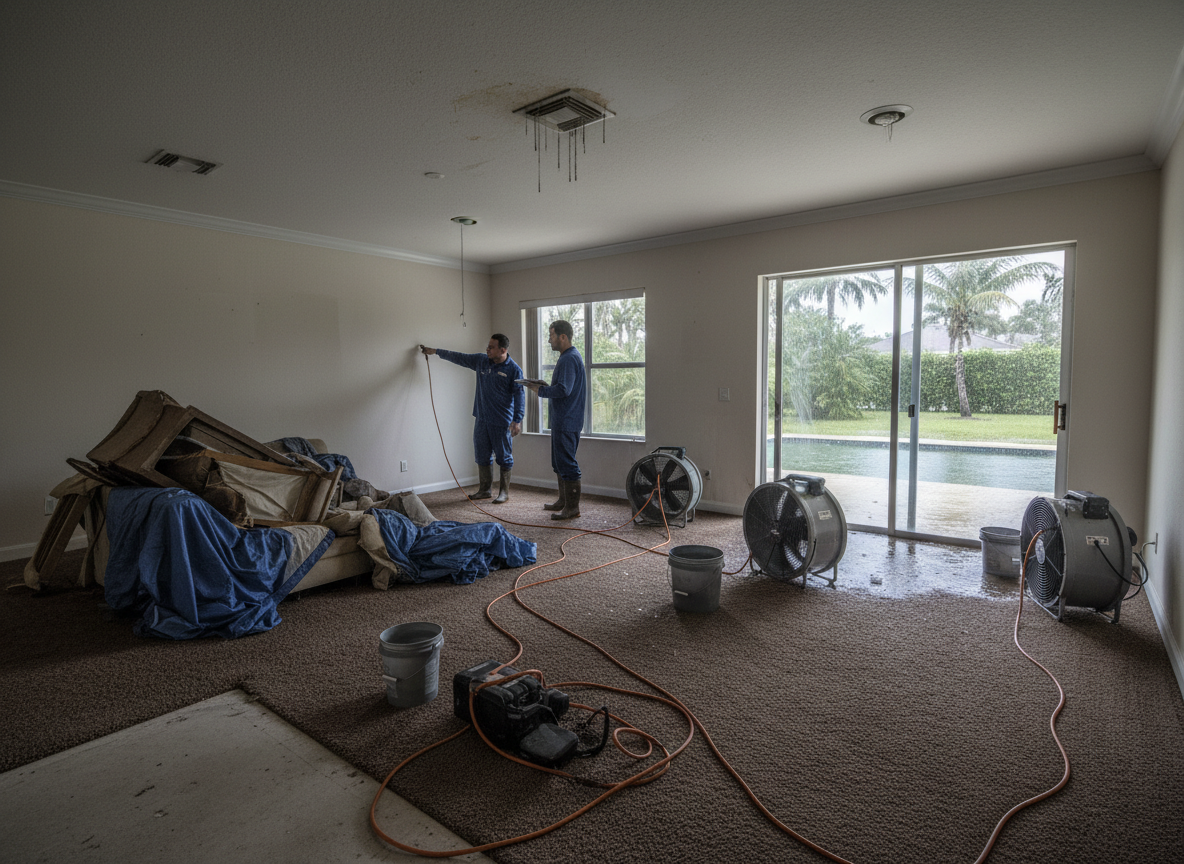
A storm passes, the street drains, the sun comes back, and the house still smells damp a week later. In West Palm Beach that sequence is common enough that it is worth understanding, because the reason is rarely the rain that fell on the roof. It is usually the water that never left.
Palm Beach County is flat. There is very little slope to move water away from a slab, and the canal network that drains the region was built to move large volumes quickly, not to dry an individual lot. When a storm drops several inches in an afternoon, the ground around a house can stay saturated for days. Water then finds the lowest available path: slab cracks, the joint where a patio meets the wall, a garage floor that sits slightly below the finished floor, or the base of a block wall where exterior grade is close to the interior line.
The water table makes this worse. In many neighbourhoods it sits close enough to the surface that a sustained storm raises it into contact with foundations and slab edges. A house does not need a visible leak to take on moisture in that situation. Capillary action through block and concrete is slow, silent and easy to miss until the baseboards swell or a musty smell appears in a closet.
Then there is the housing itself. East of Dixie Highway, older block and stucco houses often have layered renovations, terrazzo floors and additions built onto additions. West of Military Trail, the 1950s and 1960s boom left ranches with slab-on-grade construction, while later subdivisions brought frame-and-stucco walls and low-slope roofs with ceilings that hide the first sign of a leak. Each of those assemblies holds water differently, and each one dries at a different rate.
The most misleading surface in any of them is the inside face of a wall. Vinyl wallpaper, glossy paint, tile and even furniture pushed against a wall can keep a cavity wet while the room side reads dry to the touch. That is why a moisture meter belongs on the wall, not just on the carpet, and why the reading should be taken at more than one height.
Humidity is the other half of the problem. Even after the visible water is gone, Palm Beach County air holds enough moisture that a house left closed with wet materials will stay humid. Drying is not a matter of pointing a fan at a damp patch. It is a matter of removing standing water, removing material that cannot be dried, and then running dehumidification and air movement against measured targets until the assemblies reach a dry standard.
What should you check yourself after a storm? Look for cupped or lifting floor edges, dark lines at the base of walls, doors that suddenly stick, a musty smell in closets and cabinets, and any stain on a ceiling that grows. Check the garage and patio transitions, which are the most common entry points. If the house was closed up during the storm, open it and ventilate once the rain stops.
What should you not do? Do not pull up carpet or cut drywall before the moisture is read, because the removal line should follow the readings rather than guesswork. Do not paint or seal a damp wall to hide a stain. And do not assume that because the floor feels dry, the cavity behind it is dry too.
If you are unsure, have it measured. A moisture map with marked points and dated readings tells you whether you have a drying problem, a leak that is still running, or a mold problem that has already started. In this climate, that record is worth more than an opinion.